Spring is fast approaching and hopefully we will be in for some warmer weather soon. We have been having a long spell of cold weather and plenty of snow (for which I am grateful - this area needs the water in a bad way). While I wait for the earth to thaw I decided that it was about time to start another round of eggs in the incubator. I put fifteen of my freshest eggs in the incubator on Valentine's Day. I am hoping that by March 6th I will have another round of chicks from my lovely hard working flock of laying hens. This will be my third year of growing out my own eggs and it makes me happy to know that I can indeed grow a good sized flock of my own source of meat and eggs for just the price of chicken food and time.
My hatch rate last year was not the best, but I am hoping that I get another 4-6 chicks from this round. Some of my hens are getting older and the rooster may have too many hens to "service" so the fertility may not be very high. If I don't hatch very many, I may find a few more chicks at the local farm store to round out the numbers. I have been thinking about introducing new breeds into the flock, but it will depend on what is available. I would like to add a couple of Jersey giants and maybe a Wyandotte of some variety to add a little color and size to my flock. What I end up with will depend on how many eggs hatch in this round of incubation. Updates to follow.....
Tuesday, February 26, 2019
Monday, February 18, 2019
Dehydrating Potatoes
When I grew potatoes a couple years ago, I grew far more than I needed and unfortunately many of them went to waste. Last year I cut back how many potatoes that I planted and I think I have more closely matched how much I will actually use in a year, but I still have a few more than I will not be able to use before they start to go bad. Some of them will be used to plant my garden again in the spring, but in the meantime they were starting to look a little wrinkly and they had begun sprouting. In an effort to reduce wasting them this year I wanted to attempt dehydrating some to see if I can supplement my home made backpacking meals.
I started by cleaning and peeling a bunch of smaller potatoes. The majority of them were my Purple Viking potatoes, but I still had quite a few Yukon Gold, so I did a bunch of those as well. Each potato was then cubed and then dunked into a bowl of cold water while I accumulated enough for a round.
The next step is to blanch the cubed potatoes in boiling water for a few minutes. This will help to neutralize the starches in the potatoes and help them to retain a nice color while they dry. I wait long enough that they are partially cooked so they hold up better when rehydrating them. They will finish the cooking process after they are reconstituted.
After blanching they get an ice water bath until they are fully cooled and then they are drained for a few minutes before I spread them on a dehydrator tray.
Several pounds of potatoes dried down to a few ounces of potato pieces that will keep for a very long time in a mason jar. When I want to use them I only need to add boiling water to them and let them sit for a little while before I cook them up. They should make a welcome addition to my camping dinners and I look forward to using them on camping trips this summer.
Tuesday, February 12, 2019
Seed Starting Time
It's that time of year again when the weather still feels like winter, but spring isn't too far away. The sun is arriving earlier and setting a few minutes later each day and the air doesn't feel as cold as it did a month ago. Now is the time of year that I start to get my garden ready for the planting season that is just around the corner. I don't start a ton of my crops indoors, but I will give things like celery, broccoli, peppers and tomatoes a head start on spring. I do try to plant according to the moon cycle because although I am not terribly superstitious, it couldn't hurt to give some credence to an "old wives tale". Planting by the moon says that crops that you harvest from above the ground should be planted during the time that the moon is waxing, starting just after a new moon. This years garden was started on February 4th and the things I choose to start this month were my peppers (Jalapeno, Spanish Mammoth, and Paprika), celery (Tendercrisp), broccoli (Goliath), cabbage (Red Acre, Premium Flat Dutch), Oregano, Cumin, and Thyme. The brassicas will go out as soon as the weather warms a little and I plan to plant them under cover in early April if they are big enough. Next month I will start the tomatoes and tomatillos as those seem to grow fairly fast
My growing set up is fairly small as I only need to start a few dozen plants for my garden each year. It consists of a few shelving units and some small, cheap grow lights that I have bought over several years. It represents an investment of a few hundred dollars, but it should last for a very long time and the light bulbs will be the only upkeep cost for me. I keep the lights on a timer and use clear plastic bins to hold all my seedling pots. The pots themselves I have saved from year to year and I got many of them for free out of a nursery's recycle bins. With the initial investments out of the way, starting seeds each year has become a very cost effective endeavor. I only need to buy the seed and the potting soil and the rest just takes time and attention. Considering how much it costs to buy seedlings at the store or nursery I think I have made a worthy investment.
I have started my seedlings this way for the last several years and every year I get better results. Growing my own seedlings has taught me the importance of timing and spacing and it has also taught me that sometimes things won't work out the way you planned. Every year is a new experiment in growing plants and every year teaches me something different. Every seed that is planted holds the promise of new life and hope for another warm growing season ahead.
My growing set up is fairly small as I only need to start a few dozen plants for my garden each year. It consists of a few shelving units and some small, cheap grow lights that I have bought over several years. It represents an investment of a few hundred dollars, but it should last for a very long time and the light bulbs will be the only upkeep cost for me. I keep the lights on a timer and use clear plastic bins to hold all my seedling pots. The pots themselves I have saved from year to year and I got many of them for free out of a nursery's recycle bins. With the initial investments out of the way, starting seeds each year has become a very cost effective endeavor. I only need to buy the seed and the potting soil and the rest just takes time and attention. Considering how much it costs to buy seedlings at the store or nursery I think I have made a worthy investment.
I have started my seedlings this way for the last several years and every year I get better results. Growing my own seedlings has taught me the importance of timing and spacing and it has also taught me that sometimes things won't work out the way you planned. Every year is a new experiment in growing plants and every year teaches me something different. Every seed that is planted holds the promise of new life and hope for another warm growing season ahead.
Sunday, February 3, 2019
Storing my Dried Corn
It has been a few months since I harvested my Glass Gem corn and it has been waiting in my storage room for me to find the time to get it ready for real storage. I didn't harvest a huge amount of corn last year, but I think it will give me plenty of seeds to plant in this year's garden and I will still have quite a bit to share with my chickens too.
The weather had gone through a rainy period when I took these ears of corn from the stalks, so I wanted to make sure they had plenty of time to dry out before I put them away for more permanent storage. I may have forgotten about them for several months so they were plenty dried out when I "rediscovered" them this month. I decided that it was time to shuck the kernels from the cobs in order to make them take up a lot less space in storage. Separating the kernels also brought me one step closer to grinding them into cornmeal if I wanted to make cornbread from these colorful little gems. One by one I processed each cob in a labor of love. I know they make special devices to speed this process up, but I really don't have enough corn to justify getting one and I have plenty of time to do the work. When I finished I had filled twelve quart jars with a rainbow of colorful kernels.
I saved the seeds from the most colorful, largest and healthiest looking cobs for planting in this year's garden. I had only chosen an few different cobs, but they made enough seed to fill a whole quart jar themselves. I am excited to see what color combinations grow from these open-pollinated seeds of Glass Gem corn.
Tuesday, January 15, 2019
Garden Planning
Winter is only getting going, but spring will be here before I know it and I need to start preparing for the next growing season. I have made some tentative plans of where I want to plant things this year, but that always changes a little when it comes down to the actual planting of crops in the dirt. I usually try to work out the big picture first and the details will follow in due time.
I did want to try a few new crops this year, so I made some changes to my garden rotation to accommodate the new additions. I will definitely be planting fewer cucumbers this year since I am still inundated with pickles from last summer's pickling marathon. I also think I will skip planting cabbage in the fall since I can never get it to head up before it becomes over run by aphids or below freezing temperatures. My new additions will be a few different kinds of peppers and tomatillos. I also want to try growing some honeydew type melons and a new variety of winter squash.
Most of the garden will be started from seed so I will need to start some things very early to ensure that they have enough time to reach maturity before the growing season ends. The things I start indoors are usually celery, peppers, broccoli and tomatoes. I am going to add tomatillos to that list if they do well this year and if I have enough room under my grow lights I may start a few of the melons early as well. Most everything else will be direct seeded outside once the temps are steadily above freezing.
I am in the process of getting my seed starting area cleaned up and soon I will be filling the pots with dirt and seeds. Soon the hope for another great garden season will be happily growing in my kitchen.
I did want to try a few new crops this year, so I made some changes to my garden rotation to accommodate the new additions. I will definitely be planting fewer cucumbers this year since I am still inundated with pickles from last summer's pickling marathon. I also think I will skip planting cabbage in the fall since I can never get it to head up before it becomes over run by aphids or below freezing temperatures. My new additions will be a few different kinds of peppers and tomatillos. I also want to try growing some honeydew type melons and a new variety of winter squash.
Most of the garden will be started from seed so I will need to start some things very early to ensure that they have enough time to reach maturity before the growing season ends. The things I start indoors are usually celery, peppers, broccoli and tomatoes. I am going to add tomatillos to that list if they do well this year and if I have enough room under my grow lights I may start a few of the melons early as well. Most everything else will be direct seeded outside once the temps are steadily above freezing.
I am in the process of getting my seed starting area cleaned up and soon I will be filling the pots with dirt and seeds. Soon the hope for another great garden season will be happily growing in my kitchen.
Saturday, January 5, 2019
Bringing In the New Year
2019 began with a snowstorm that dropped an unusual amount of snow on this high desert landscape. The pure white blanket that covered the earth made for a beautiful little hike to help bring in the new year. It was a gentle reminder of how a new year can mark a fresh start. The slate can be wiped clean and if things aren't going the way you had hoped, this is just a chance to begin again. May your journeys be all that you can dream them to be.
Sunday, December 23, 2018
Spinning a Yarn
The weather has turned much colder in the last few weeks. Our highs have hovered in the 30s and our lows have dipped into the teens overnight. The days have become noticeably shorter as well and the sky is now dark by 5 pm. This leaves a lot of indoor time for winter projects like crocheting hats and spinning new yarn.
I do have a few pounds of roving that I wanted to process, so I picked up where I left off last spring with a roll of white merino roving. I spun the roving into thin singles and then double plied them into a soft worsted yarn.
The next step was to wind this bobbin of yarn onto a niddy noddy to make it into a skein of yarn.
A niddy noddy does two things. First it keeps the yarn organized and untangled as it forms large loops that will become the skein. Second it is a way to measure the length of the yarn so you have an idea of how much yarn you have to work with for a project.
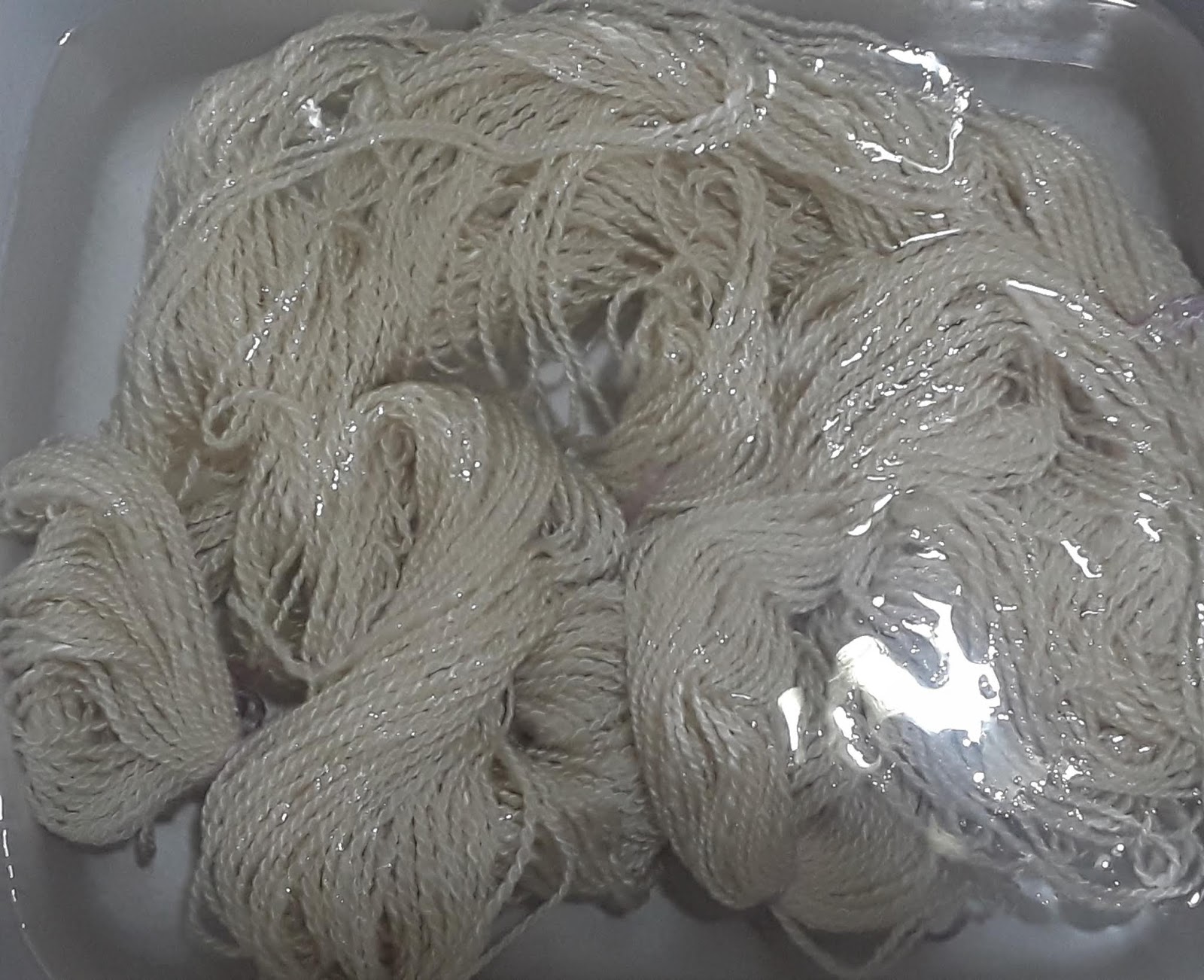
From the niddy noddy, the new yarn gets plunged into a cold bath for a few hours to help set the twist in the yarn.
Setting the twist happens when the yarn fibers expand in the water. The twist relaxes a bit and the yarn takes on a more even appearance. I am careful not to agitate the yarn while I soak it because I don't want the fiber to felt. After a couple of hours I gently squeeze the water out of the skein and hang it to dry for a few days. Once it is completely dry I twist the yarn into a skein.
At this point the yarn is ready to become anything. I can dye it any color I would like or just use it the way it is to make whatever I can dream up. I don't have a set plan for this yarn yet. I think this winter's goal will be to spin as much roving as I can to create a little handspun stash of yarn for all my future projects. It will be nice to have a variety of my own handspun yarns to work with once I work my way through my fiber stash.
I do have a few pounds of roving that I wanted to process, so I picked up where I left off last spring with a roll of white merino roving. I spun the roving into thin singles and then double plied them into a soft worsted yarn.
The next step was to wind this bobbin of yarn onto a niddy noddy to make it into a skein of yarn.
A niddy noddy does two things. First it keeps the yarn organized and untangled as it forms large loops that will become the skein. Second it is a way to measure the length of the yarn so you have an idea of how much yarn you have to work with for a project.
From the niddy noddy, the new yarn gets plunged into a cold bath for a few hours to help set the twist in the yarn.
Setting the twist happens when the yarn fibers expand in the water. The twist relaxes a bit and the yarn takes on a more even appearance. I am careful not to agitate the yarn while I soak it because I don't want the fiber to felt. After a couple of hours I gently squeeze the water out of the skein and hang it to dry for a few days. Once it is completely dry I twist the yarn into a skein.
At this point the yarn is ready to become anything. I can dye it any color I would like or just use it the way it is to make whatever I can dream up. I don't have a set plan for this yarn yet. I think this winter's goal will be to spin as much roving as I can to create a little handspun stash of yarn for all my future projects. It will be nice to have a variety of my own handspun yarns to work with once I work my way through my fiber stash.
Subscribe to:
Posts (Atom)